
In long-term care, our greatest lever to success is a culture of continuous quality improvement.
The process of incremental change, discovered only by being aware of how every effort is expended, is how long-term care will improve.
Considering each resident for the person they are behind the medical chart is how outcomes of care improve quality of life.
Example:
BCIT’s class on April 13, 2026, introduced the idea of person-centred care.
Student homework was to present a practical, cost effective, and actionable idea that is person-centered and engaged family. friend care partner in the process.
Ideas included:
– Upon admission, have the family bring a photo album that staff, family, and residents could pick up and thumb through to spark fond memories, warm feelings, and conversation.
– Another form of familiarity, “getting to know me,” tool is a family tree. The family could work with a care home template that results in a poster-sized tree to place on the wall.
– Embedding cultural sensitivity and inclusivity into long-term caring was raised. The ultimate tribute to person-centered care is honouring a person’s background culturally (especially food preferences). While aspirational, the value of person-centered care has already been proven. Even the occasional efforts to incorporate familiar menu items could make a difference.
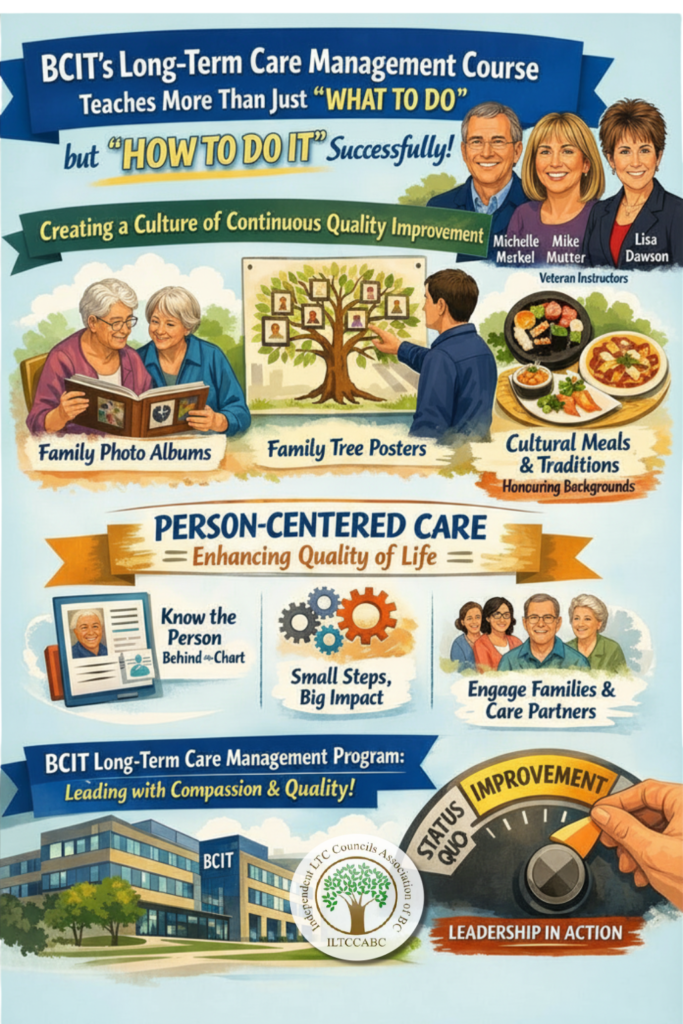
BCIT Instructors, Michelle Merkel and Mike Mutter, led the class.
Michelle Merkel: Experienced Practice Manager. Skilled in Clinical Nurse Management, Project Management, Change Management, Quality Improvement and Patient Safety, to name a few areas of focus.
Mike Mutter: Experienced in roles with UFV and BC Ambulance, Mike received the “Standout Initiative Award” at UFV for work in continuing education.
Guest instructor Lisa Dawson (15+ years of experience as a care partner for her Father in long-term care) added to the conversation. Lisa is also President of The Independent Long-Term Care Councils Association of BC
BCIT offers a Long-Term Care Management program, designed to ensure essential skills for effective leadership in long-term care. It fosters a culture of continuous quality improvement, ensuring residents’ safety, security, and satisfaction in their care experience.
In BC, long-term care homes, a designated manager is not simply an operational requirement — it is the person ultimately accountable for the daily lived experience, safety, dignity, and quality of life of every resident. Serving as Site Leaders, these individuals are responsible 24 hours a day for regulatory compliance, staff performance, risk management, and the delivery of increasingly complex clinical and relational care.
This level of responsibility cannot be entrusted to good intentions or general management experience alone; it requires the specialized insight, systems thinking, and leadership skills that come from having completed a dedicated long-term care management course.