Grief and bereavement in long-term care constant but often under-recognized part of life in long-term care. Residents, families and staff may experience many forms of loss, including declining health, changing abilities, separation from familiar surroundings, the death of residents and the loss of relationships formed within the care community.
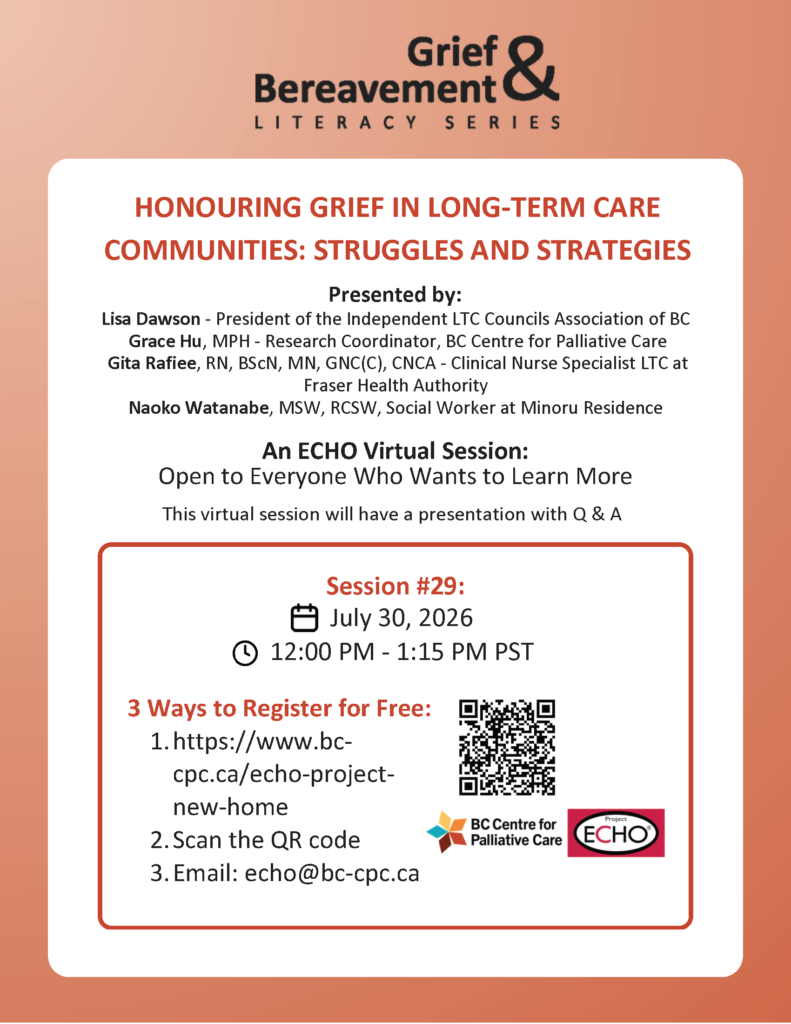
On July 30, 2026, the BC Centre for Palliative Care hosted an ECHO virtual learning session titled Honouring Grief in Long-Term Care Communities: Struggles and Strategies as part of its Grief & Bereavement Literacy Series.
The session brought together perspectives from long-term care, family advocacy, social work, clinical practice and palliative care to explore the challenges surrounding grief in long-term care and practical strategies for making grief-informed conversations and support part of everyday care. Lisa Dawson, President of the Independent Long-Term Care Councils Association of BC (ILTCCABC), was among the presenters and contributed a family advocacy and Family Council perspective to the discussion.
A Gap in Long-Term Care
British Columbia currently does not have a province-wide, standardized and mandated process specifically outlining how long-term care homes should support residents, families and staff through grief and bereavement.
Provincial guidance recognizes grief and family support as important parts of palliative and end-of-life care. However, there is no consistent workflow, licensing expectation or dedicated provincial quality indicator focused specifically on grief and bereavement support in long-term care.
The provincial Long-Term Care Quality Framework provides direction for measuring and improving quality in long-term care. Its current indicators address areas such as safety, access, resident quality of life, pain, social engagement and the presence of Resident and Family Councils. However, grief and bereavement are not currently identified as distinct quality indicators.
This is an important gap. The challenge cannot be addressed only by providing education to individual care homes or relying on local leaders to prioritize the issue. Meaningful and sustainable change also requires recognition and support at the broader organizational and provincial levels.
Building Grief Literacy in Long-Term Care
Grief literacy is the ability to recognize grief, understand how it may affect people and respond in compassionate and helpful ways.
In long-term care, grief is not limited to the period following a death. Residents may grieve the loss of independence, health, familiar routines and community. Families may experience anticipatory grief as a loved one’s condition changes. Staff may also grieve residents with whom they have developed meaningful relationships, while continuing to support other residents and families.
The July 30 learning session explored the struggles experienced across long-term care communities and the strategies that can help make grief literacy part of day-to-day conversations, relationships and care practices.
The discussion emphasized the importance of:
- Recognizing the different forms of grief experienced by residents, families and staff.
- Creating safe and compassionate opportunities to acknowledge loss.
- Including grief-informed approaches in everyday communication and care.
- Supporting staff who experience repeated losses in their work.
- Strengthening collaboration among residents, families, care teams and organizational leaders.
- Moving beyond individual initiatives toward consistent and sustainable approaches across long-term care.
Grief is not an isolated event or an issue that can be addressed through a single presentation. It is an ongoing part of long-term care that deserves open discussion, compassionate responses and greater attention within policy, quality improvement and everyday practice.
ILTCCABC welcomes opportunities to work with residents, families, long-term care teams and provincial partners to help ensure that grief and bereavement are recognized as important parts of person-centred long-term care.
Resources and presentation materials from the session will be added to this page when available.
To explore additional education and resources related to long-term care, visit the ILTCCABC Education Portal.