
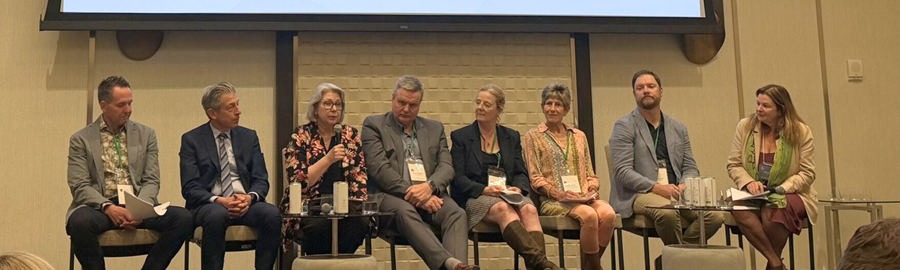
On May 6, 2026, ILTCCABC President Lisa Dawson joined a panel at the Canadian Centre for Healthcare Facilities Conference to discuss the rising cost of long-term care and how to unlock new capacity at a time when projects are being paused or cancelled. Lisa opened up the panel discussion to set the scene for this long-term care conversation from the resident and family perspective:
16 years ago, when my Dad moved into his LTC home, I thought his health would be the hardest part.
I didn’t realize how much the hallway length, the lighting, the distance to the bathroom, and the noise would shape his mood, his safety, and how much time staff had for him.
A long-term care home is not just a building. It’s a tool.
It either gives staff time to care — or quietly takes it away.
If we want projects in BC to move faster, cost less, and be truly resident-centred, we must design for the people who live and work there every day — not just for construction efficiency.
Gerontologists agree: Buildings and beds are essential, but they are only part of the picture.
I have been asked by residents and families of long-term care homes across the province to relay this message in the hopes that discussions here are about preventing mistakes that cost us our service delivery and resident well-being
Who Lives in LTC Now
Today’s residents entering LTC are more frail, more complex, 85% living with dementia, and dependent in daily living. …And there are a growing number of them!
Today’s residents require both complex clinical care and sustained relational support for ongoing management of chronic, daily health needs – they need more staff per resident ratio.
If we design for “independent seniors,” we build the wrong buildings.
The modern LTC residents cannot navigate long corridors, poor lighting, or confusing layouts.
They wake at 2 am disoriented.
They need help with everything.
They rely on care aides, not architecture that assumes independence.
Design must assume confusion, mobility limits, and constant assistance.
Where does Care Break Down?
Care breaks down at shower time, mealtime, medication pass, and supporting the resident’s activities of daily living
– Sensory Overload and Fear take over in Bathrooms that echo, are cold and look like storage rooms
– Rushed Routines overlook resident needs in the moment – if a resident is not ready to eat when a meal is served, there is no time to circle back later or provide access to that meal when the resident is ready to enjoy it.
– Resident alert system – the call bell – the lack of quick response to call bells for toileting needs, leads to incontinence accidents, skin breakdown and Reduced Dignity
Staff lose time walking, searching for supplies, redirecting residents, and managing falls.
Design can support improved staff time efficiency and better care for residents.
How do we Design That Saves Staff Time?
Simple things can change everything:
Dementia-Friendly Wayfinding Prevents Crises
Straight path from bed to bathroom, motion-sensor lighting, zero-threshold flooring, contrasting walls and floors, and clear visual cues prevent falls, fear, and responsive behaviours.
Good design creates more care time for each care team member –
A Design That Saves Staff Time Every Hour …. is one that includes Care nooks between rooms, decentralized workspaces, clear sightlines to areas where residents congregate, proper storage, and separation of noisy areas
…less walking, less searching, and more caring.
Of course, Staffing, while not a design feature, does need to be addressed.
If we underinvest in relational care, we pay later system costs.
I was inspired by a recent post about a conversation a colleague had with Jodi Hall, CEO of the Canadian Association for Long Term Care:
“Retention is shaped by everyday experience.
Leadership.
Support.
Growth opportunities.
AND Work environments that actually work.
Long-term care is relational work. Stability and consistency matter.”
So the question isn’t just how we bring people in.
It’s how we create places they want to stay.
What do our family councils tell us that Must Never Be Cut?
Private rooms.
Resident/Family/Recreation Flex space.
Outdoor access
Small living areas or HUBS.
Dementia-friendly design.
These are operational necessities, not extras.
Why must Resident and Family Councils Be Involved Before Design Is Final?
Only residents and families can answer how the spaces they spend time in feel. Resident and Family Councils observe how staff move through these spaces and how it affects everything from mood to food quality.
How can BC create the right space for those who need it?
We can speed projects up by:
1. Standardizing dementia-friendly layouts that work.
We know what works. We know how to adapt that to urban and rural settings. We should standardize it provincially to cut red tape.
2. Designing for how staff actually work.
If we design for relational care and staffing reality, we reduce falls, burnout, turnover, and medication use — all major operational costs.
3. Measuring lifetime operating costs, not just construction cost will lead to better economic decision making
The cheapest build is often the most expensive home to run.
4. Family and Resident Councils suggest …. it’s not what you make, it’s what you save…that should be part of this equation
So, these next 3 thoughts are ways to free up and save care home space instead of building new:
1. Different populations require different models of care, environments, and expertise.
Take a page from Alberta’s playbook. They are undertaking a multi-billion-dollar, 10-year expansion of continuing care capacity, promising thousands of spaces to support an aging population with different needs in different ways. Separate buildings in the best cases, and separate floors in other cases, but meeting people where their needs lie:
Continuing Care Home (Long-Term Care):
Continuing Care Home (Designated Supportive Living):
Continuing Care Home – (Dementia Care)
Continuing Care Home D (Hospice):
2. Consider repurposing some AL beds for a period of time -There are over 206 registered assisted living sites in BC, providing a total of 8,428 registered units.
AL is seeing the demise of dancing and happy hour in exchange for companion support and wheelchairs
3. Another lever is to accept that Home Support is Healthcare – Just make Home Support accessible for all who are in need. According to the Seniors’ Advocate Report, we must do better, one hour of daily home support costs the government $14,100 per year, compared to $59,900 for a long-term care bed, demonstrating significant savings for the public system. Long-Term Care needs Homecare!
In closing, the question is not just “How do we build more LTCHs cheaper?”
The question is:
“How do we create space with design in mind, so staff have time to care, and residents feel well supported?”
That’s how BC builds better LTC and improves care at the same time.